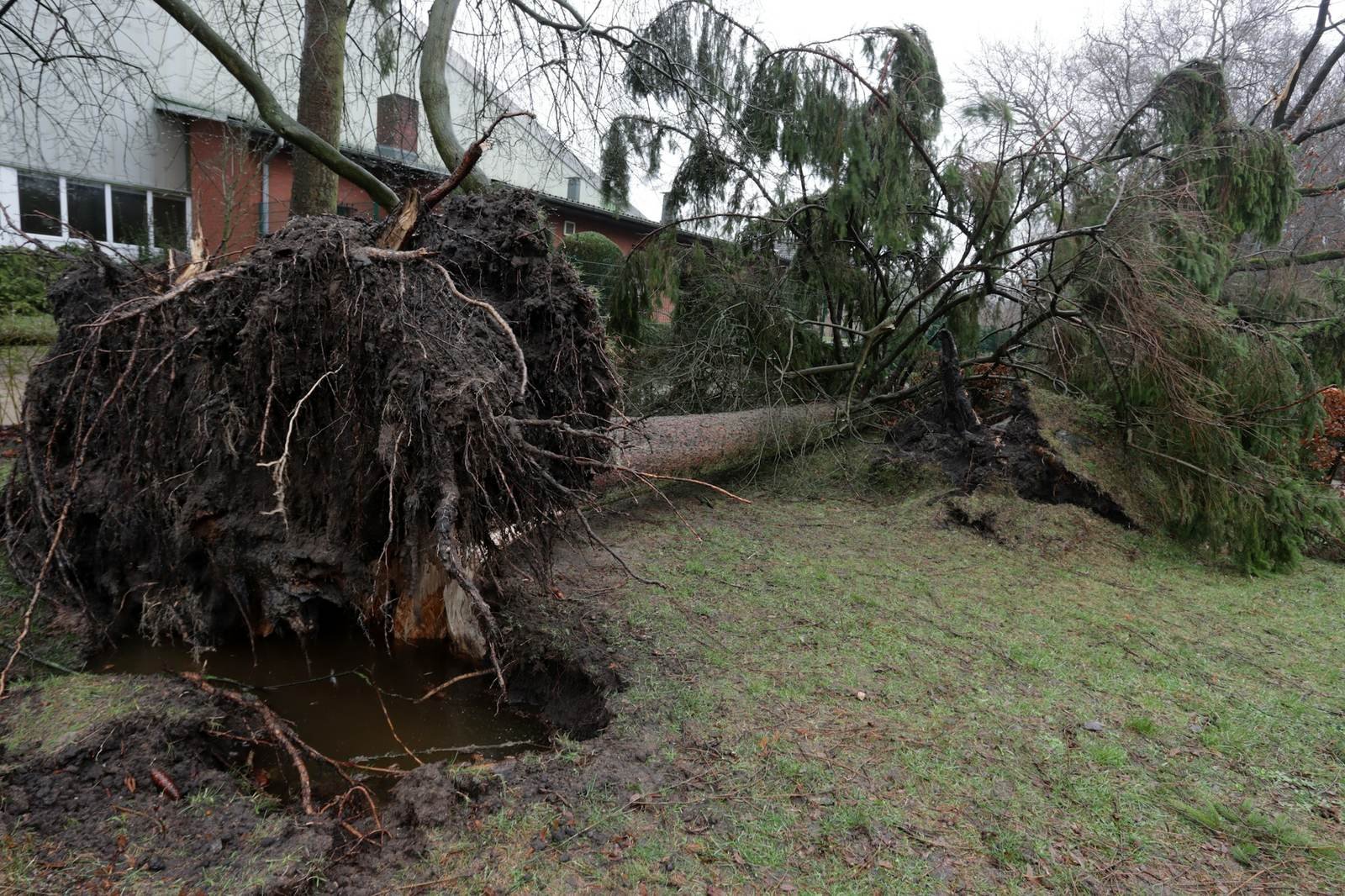
Every policy is different. This guide explains how standard homeowners policies usually work. Your declarations page and your agent have the final word on your coverage.
When insurance usually pays
A tree falls on your house or another insured structure
This is the main case insurance is built for. If wind, lightning, hail or the weight of ice brings a tree down on your house, garage, shed or fence, a standard policy generally covers the damage to the structure, after your deductible. It also pays to remove the tree from the structure, usually under a separate debris removal limit.
It doesn't matter whose tree it was. If your neighbor's tree lands on your house, your policy is still the one that pays. See who pays when a neighbor's tree falls.
A tree blocks your driveway or ramp
Many policies will pay to remove a fallen tree that blocks your driveway or a wheelchair ramp, even when it didn't damage anything, up to the same removal limit. Read your policy's "trees" or "debris removal" section, because the exact conditions vary.
When insurance usually doesn't pay
- Removing a tree before it falls. Preventive removal and trimming are maintenance, and standard policies don't cover them.
- A tree that falls and hits nothing. If it lands in the yard without damaging an insured structure or blocking access, cleanup is usually on you.
- Neglect. If the tree was obviously dead or rotten for a long time, an insurer may argue the loss came from poor maintenance rather than the storm.
- Replacing the tree. The cost of a new tree is generally not covered.
- Your car. That goes to the comprehensive coverage on your auto policy.
Removal limits are often lower than the bill
Here's the part that surprises people. Many standard policies cap tree debris removal at roughly $500 per tree and $1,000 per storm. Some policies pay more, and the cost of fixing the house itself is a separate, higher limit. A big oak on a roof can take a crane and a full crew, so the removal bill can be higher than the removal limit. See what tree removal costs in Chattanooga.
Insurers also tend to separate two jobs: getting the tree off the house, which is covered, and cleaning up the rest of the tree in the yard, which often isn't. Ask the crew to itemize the invoice so the adjuster can see which is which.
How to make a smooth claim
- Photos and video first, before anything is moved.
- Call your insurer and ask what your tree and debris removal limits are, and whether they want an adjuster to see it before work starts.
- Prevent more damage. Tarping the roof and getting the weight off the house are expected. Keep every receipt.
- Get an itemized invoice from the tree crew.
- Be careful with "we'll handle your insurance" offers from crews who knock on your door after a storm. Don't sign over your insurance benefits to anyone you haven't vetted.
The cheapest claim is the one you never file
Insurance won't pay to remove the dead pine leaning toward your bedroom, but it will pay, with a deductible and a lot of hassle, after the pine comes through the roof. If there's a tree you've been worrying about, getting a quote now usually costs less than the deductible. Call (423) 356-6500 or use the form below.
Common questions
Will insurance pay to remove a dead tree before it falls?
Almost never. Standard homeowners policies cover sudden damage, not maintenance. Taking down a dead or risky tree before it fails is on the homeowner. It's also usually far cheaper than the damage it would cause.
How much will insurance pay for tree removal?
It depends on your policy. Many standard policies cap debris removal for fallen trees at around $500 per tree and $1,000 per storm, while some policies pay more. Check your declarations page or ask your agent.
Does insurance cover a tree that fell in my yard but didn't hit anything?
Usually not. The common exceptions are a tree blocking your driveway or a wheelchair ramp, which many policies will pay to clear up to the removal limit.
Does homeowners insurance cover a tree falling on my car?
No. Damage to your car goes through the comprehensive coverage on your auto policy, if you have it.