This is general information, not legal advice. Every case turns on its facts. If a lot of money is at stake, talk to your insurance agent and a local attorney.
Step one: call your own insurance company
It feels backwards, but your own homeowners policy is usually the first stop, even when the tree was your neighbor's. Policies cover damage to your house, garage and other insured structures from covered events like wind and the weight of ice. You pay your deductible, and the insurer pays the rest of the covered repair.
If your neighbor ignored a tree that was obviously dead or dangerous, your insurer may go after them, or their insurer, to get its money back. That process is called subrogation, and it can also get your deductible returned. You don't have to sue anyone yourself to get your roof fixed. See what homeowners insurance covers for trees.
When is your neighbor responsible?
Both Tennessee and Georgia start from the same idea: a tree owner isn't automatically responsible every time a tree falls. What matters is whether they knew, or should have known, the tree was a danger.
Tennessee
In Lane v. W.J. Curry & Sons (2002), the Tennessee Supreme Court held that encroaching trees and roots can be a nuisance when they cause actual harm, or pose an imminent danger of harm, to the property next door. The neighbor who owns them can be held responsible. The court also confirmed that you can cut back encroaching branches and roots at your own expense.
For a tree that falls, Tennessee courts generally look at ordinary negligence. A healthy tree that comes down in a storm is usually treated as nobody's fault. A tree that was visibly dead, rotten or leaning, where the owner knew or should have known it could fall, is a different story.
Georgia
Georgia's rule is stated plainly in UGA Extension's guide to tree ownership: the owner is liable for damage from a falling tree only if they knew, or reasonably should have known, that it was diseased, decayed or otherwise dangerous. Georgia law does not impose a general duty to inspect trees. Courts have held that the problem has to be one a layperson could have spotted, not just something an arborist found after the fact.
That's why written notice matters so much in Georgia. A letter, an email or an arborist's report telling the owner about a dead tree makes it much easier to show they knew.
Who owns the tree?
- The trunk decides. A tree belongs to the owner of the land where its trunk stands, even if most of the branches hang over your yard.
- Trunk on the line? A tree whose trunk straddles the property line is generally shared, and so is the responsibility for it.
- City trees. If the tree stood in the right-of-way, it may belong to the city. See Chattanooga tree permits and street trees.
What to do after a neighbor's tree comes down
- Stay safe. Keep away from any wires and call EPB or your power company. If the tree hit the house, follow our tree on a house checklist.
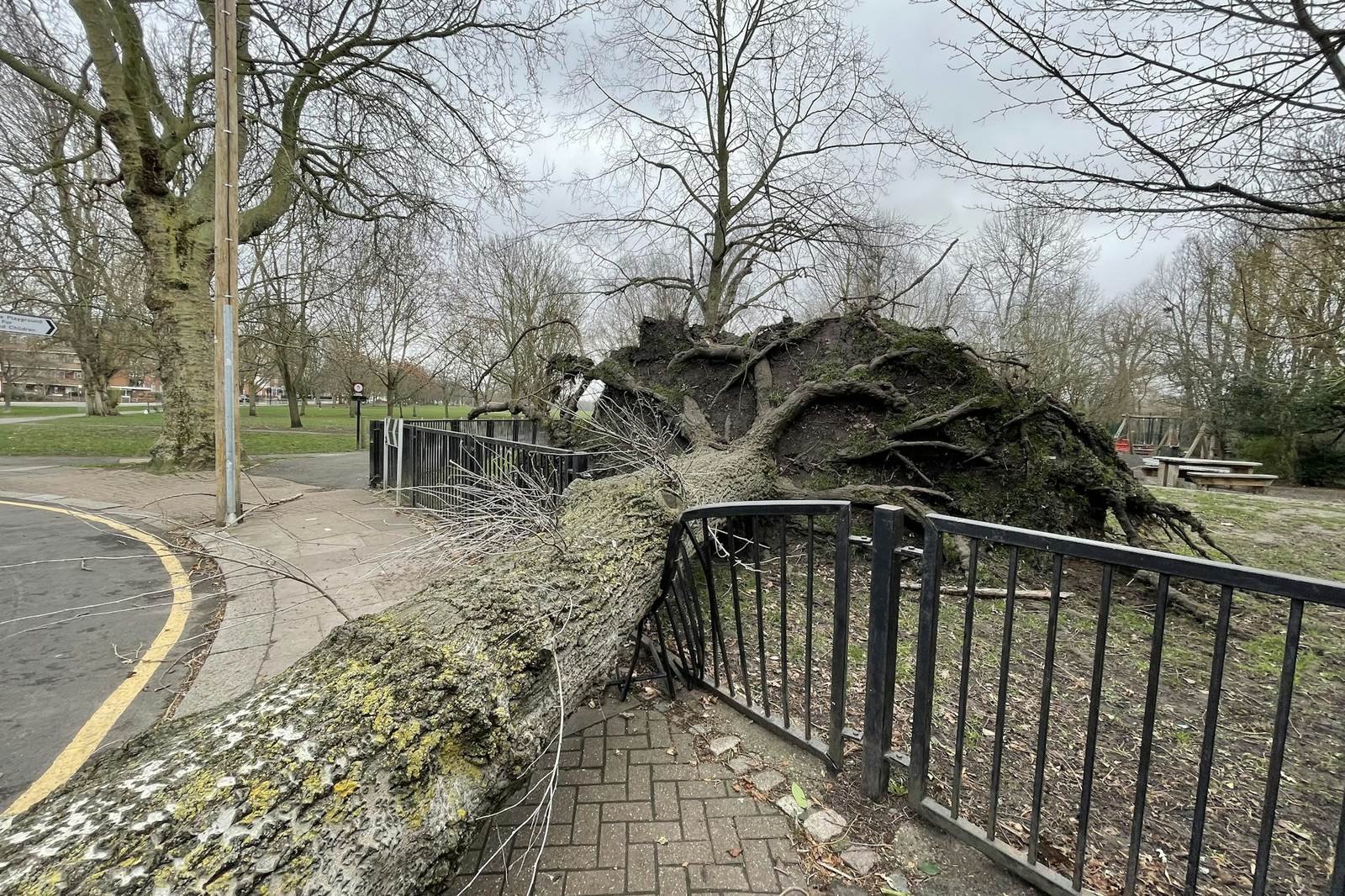
- Photograph everything before it's moved: the damage, the whole tree, the broken end and the stump or root ball. Rot or hollow wood at the break is important evidence.
- Tell your neighbor and ask for their insurance information.
- Open a claim with your own insurer.
- Get the tree off your property. Your insurer expects you to prevent more damage. Keep the invoice, and ask the crew to note anything they see about the tree's condition.
Heading off the problem
If a neighbor's tree looks like a threat today, the best time to deal with it is now. Talk to them, put your concern in writing, and offer to split the cost of an arborist's opinion. Many neighbors will happily share the cost of removing a dead tree once they see it written up. It's a lot cheaper than a roof.
Common questions
If my neighbor's tree falls on my house, whose insurance pays?
Usually yours. Homeowners policies cover damage to your property from a covered event like wind, whoever owned the tree. If your neighbor was negligent, your insurer may try to recover the cost from them.
Is my neighbor liable if a healthy tree blew over in a storm?
Usually not. In both Tennessee and Georgia, a healthy tree brought down by wind or ice is generally treated as nobody's fault. Liability usually depends on the owner knowing, or having reason to know, that the tree was dead, decayed or dangerous.
Can I cut branches that hang over my yard?
Generally yes, back to the property line and at your own expense, as long as you don't kill or badly damage the tree. Talk to your neighbor first. If you need to go onto their land or take the whole tree, you need their permission.
How do I put my neighbor on notice about a dangerous tree?
Tell them in writing, keep a copy and take dated photos of the problem: dead limbs, a split trunk, fungus at the base or a new lean. A written opinion from an arborist is even stronger. This matters later if the tree fails.